 Advances in Engineering Advances in Engineering features breaking research judged by Advances in Engineering advisory team to be of key importance in the Engineering field. Papers are selected from over 10,000 published each week from most peer reviewed journals.

Hanson AJ, Thakur S.
Journal of Molecular Graphics and Remodelling, September 2012
Abstract
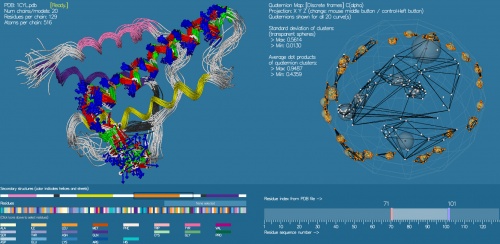
The geometric structures of proteins are vital to the understanding of biochemical interactions. However, there is much yet to be understood about the spatial arrangements of the chains of amino acids making up any given protein. In particular, while conventional analysis tools like the Ramachandran plot supply some insight into the local relative orientation of pairs of amino acid residues, they provide little information about the global relative orientations of large groups of residues. We apply quaternion maps to families of coordinate frames defined naturally by amino acid residue structures as a way to expose global spatial relationships among residues within proteins. The resulting visualizations enable comparisons of absolute orientations as well as relative orientations, and thus generalize the framework of the Ramachandran plot. There are a variety of possible quaternion frames and visual representation strategies that can be chosen, and very complex quaternion maps can result. Just as Ramachandran plots are useful for addressing particular questions and not others, quaternion tools have characteristic domains of relevance. In particular, quaternion maps show great potential for answering specific questions about global residue alignment in crystallographic data and statistical orientation properties in Nuclear Magnetic Resonance (NMR) data that are very difficult to treat by other methods.
Additional information:
Quaternion maps of protein amino acid residues provide an alternative to Ramachandran plots for orientation analysis. Several alternative orientation frame systems can be chosen, with the residue-local C-alpha-centered frame being the default. Quaternion maps are noteworthy for their ability to compare the orientations of arbitrary sets of sequential or non-sequential residues located anywhere on the protein, and for the resulting opportunity to observe and analyze the statistical properties of global orientation clusters. Only the quaternion representation of orientation frames embodies a natural rigorous measure for comparing properties of sets of global orientation frames.
Go to Journal
