Advances in Engineering Advances in Engineering features breaking research judged by Advances in Engineering advisory team to be of key importance in the Engineering field. Papers are selected from over 10,000 published each week from most peer reviewed journals.

Chemical Engineering Journal, Volume 259, 1 January 2015, Pages 552-561.
Shen, Y.J. Wang, J.H. Xu, G.S. Luo.
State Key Laboratory of Chemical Engineering, Department of Chemical Engineering, Tsinghua University, Beijing 100084, China.
Abstract
Porous glass supported with titanium silicalite (TS-1) particles were successfully prepared and used for oxidative desulfurization (ODS) of dibenzothiophene (DBT) and 4,6-dimethyldibenzothiophene (4,6-DMDBT). Uniform-sized TS-1 particles were homogeneously dispersed on the surface of the porous glass beads. Effects of reaction duration, catalyst content, initial concentration, oxidant amount, and temperature on conversions were investigated. The prepared catalysts showed excellent catalytic performance. The optimal mole ratio of oxidant-to-DBT was 10 or 15. Complete conversion was obtained within 3 min at 343 K using catalyst with Ti content of 0.507 wt.%. Compared with other studies, the space–time yield was increased by one order of magnitude without any addition of solvent or metal nanoparticles. Experimental results and computer simulations revealed that the coordinated state of Ti species has a key role in the catalytic activity. Spent catalyst would be regenerated by heating at high temperature, no decrease was observed in catalytic activity after three cycles.
Go To Chemical Engineering Journal
Significance statement:
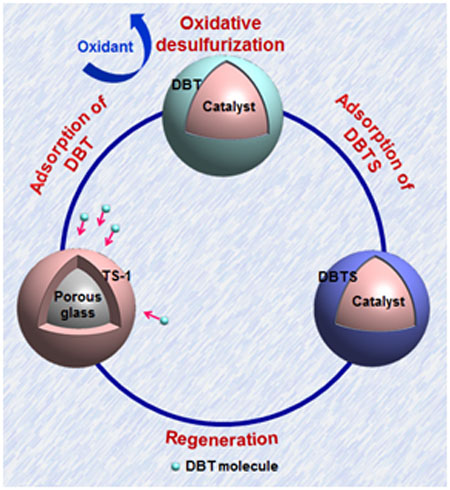
Porous glass beads supported with TS-1 particles have been successfully prepared and used as the catalyst for oxidative desulfurization of DBT. The composite material showed high catalytic activity and good stability proving an alternative for producing ultra-clean fuels in a green way. Due to the good adsorptive property for organosulfur compounds, the catalyst integrates the reaction and separation of product in one step.
Figure legend
Adsorption-reaction-adsorption-regeneration cycle of TS-1 supported on porous glass.