 Advances in Engineering Advances in Engineering features breaking research judged by Advances in Engineering advisory team to be of key importance in the Engineering field. Papers are selected from over 10,000 published each week from most peer reviewed journals.

Wang Yi, Jiang Wei, Liang Lixin, Liu Hongying, Liu Yaqing, Li Fengsheng
Rare Metal Materials and Engineering, Volume 41, Issue 1, January 2012
Abstract
Al-Mg alloy, as a kind of promising solid fuel applied in impact-initiated energetic materials, was fabricated by bi-direction rotation ball milling. Structure characterization reveals that the surface of Al0.8Mg0.2 granular particles exhibits a mass of nanostructure with size of 15–30 nm and the crystallite size decreases from more than 100 nm (raw Al) to 22.7 nm (Al0.8Mg0.2) after mechanical alloying. Thermal analysis indicates that Al0.8Mg0.2 presents excellent thermal reactivity. In the air, Al0.8Mg0.2 will be oxidized by O2 distinctly before melting. Moreover, the high temperature reaction of Al0.8Mg0.2-O2 is advanced by 33 °C compared with Al-O2 system. TG traces show that about 69.13% of Al0.8Mg0.2 are oxidized when the temperature increases to 1100 °C, but the value is merely 15.52% for raw Al. Using the alloy in thermites, other than Al-Fe2O3, Al0.8Mg0.2-Fe2O3 system presents a considerable solid-solid reaction. In addition, for Al0.8Mg0.2-Fe2O3, the average active energy of solid-solid reaction is lower by 331.664 kJ·mol−1 than that of the liquid-solid reaction, which means an advantage in ignition.
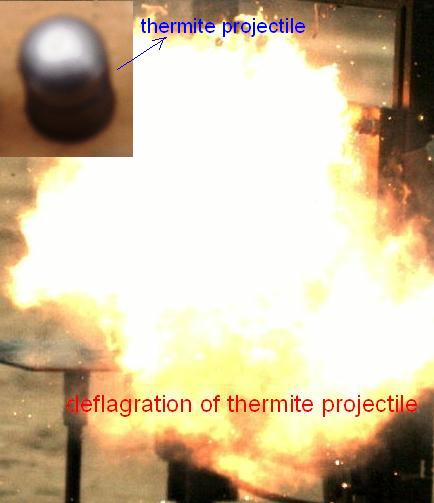
Improved thermites for impact initiated energetic materials:
As is a kind of energetic materials, thermites can release enormous heats during the combustion. Of course, thermite reaction is the chemical reaction that was discovered 200 yeas ago. They served as solder for rail and powders in combustion bomb because the high burning heats can make steel melt easy and burn down the hard targets. Now, did you think what they can be used to do if only several gram thermites were compacted into rigid little projectiles? To joint the rail?Can not; to ignite the hard target? May not. It should be a good proposal to use these little projectiles as impact initiated energetic materials. This kind of materials will be ignited by impact action and show their excellent energy release characteristics during penetration process. However, note that the energy release is not the dominating effect for target damage; it is only a complementary of penetration in that course. Because of which reason, reaction performance of the projectiles becomes the most crucial factor (the poor performance can not support the further damage to hard targets). In this case, kinetics parameters are more important than thermodynamics data for a thermite reaction. In the mechanism of the solid-solid reaction between metallic particles and metal oxides, the reaction performance is determined by thermal reactivity of the fuel(s). At present, two methods were employed to largely promote the thermal reactivity of aluminum, i.e. that using nano-Al or Al-based alloy particles (with nanometer structures) as the fuel(s). The later is more promising due to the low cost, high yield, and high reactivity. For fabricating Al-based alloy particles, our center (National Special Superfine Powder Engineering Research Center of China) performed the research for many years and can provide several advanced technologies. Besides Al-Mg alloy particles, other alloy particles that were used as high reactivity fuels in various energetic materials were also exploited in our center.
Go to Journal
